
Salesmaster is a point-of-sale (POS) app for baking and cooking supply stores on Android, iPhone & iPad, Windows and Mac. One product, such as all-purpose flour, can be sold in several pack sizes as variants, each with its own price, barcode and stock. You can also keep delivery orders with Save order, reward regular bakers with loyalty points, and see real net profit in Finance.
Problems every baking supply store knows
If any of these sound familiar, this page is for you.
- 01
One product, many pack sizes
Flour comes in 2 lb, 10 lb and 50 lb sacks. Sugar, margarine and milk powder do too. If the cashier has to remember every price, a wrong total is only a matter of time.
- 02
The holiday baking rush
In the weeks before Thanksgiving and Christmas, home bakers and small cookie businesses arrive with long lists at the same time. Ringing everything up by hand makes the line grow.
- 03
Repacked stock never adds up
Sacks get opened and repacked into smaller bags, but nobody writes down how many were opened. At the end of the month, the shelf and the stock book disagree.
- 04
Busy store, thin margins
Baking staples sell with small margins. After stock purchases, rent, wages and deliveries, you're not sure the store actually made money.
Building your catalog: categories and pack-size variants
Start with the shelves you already have. In Salesmaster, every product is one item in the Catalog. Group them into categories such as Flour & sugar, Butter & dairy, Chocolate & flavorings, and Pans & packaging, so the cashier finds any product in one or two taps on the Sale screen.
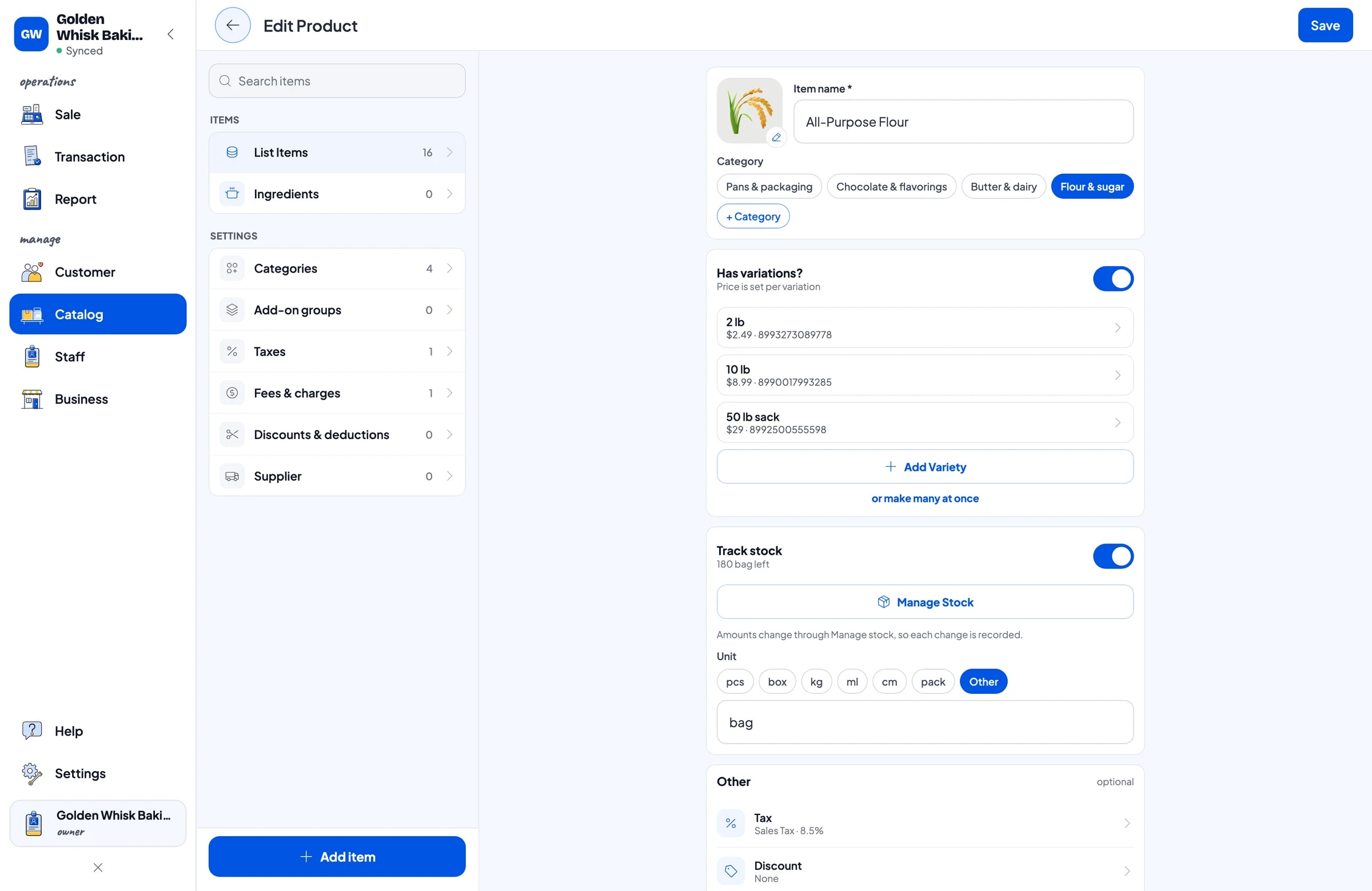
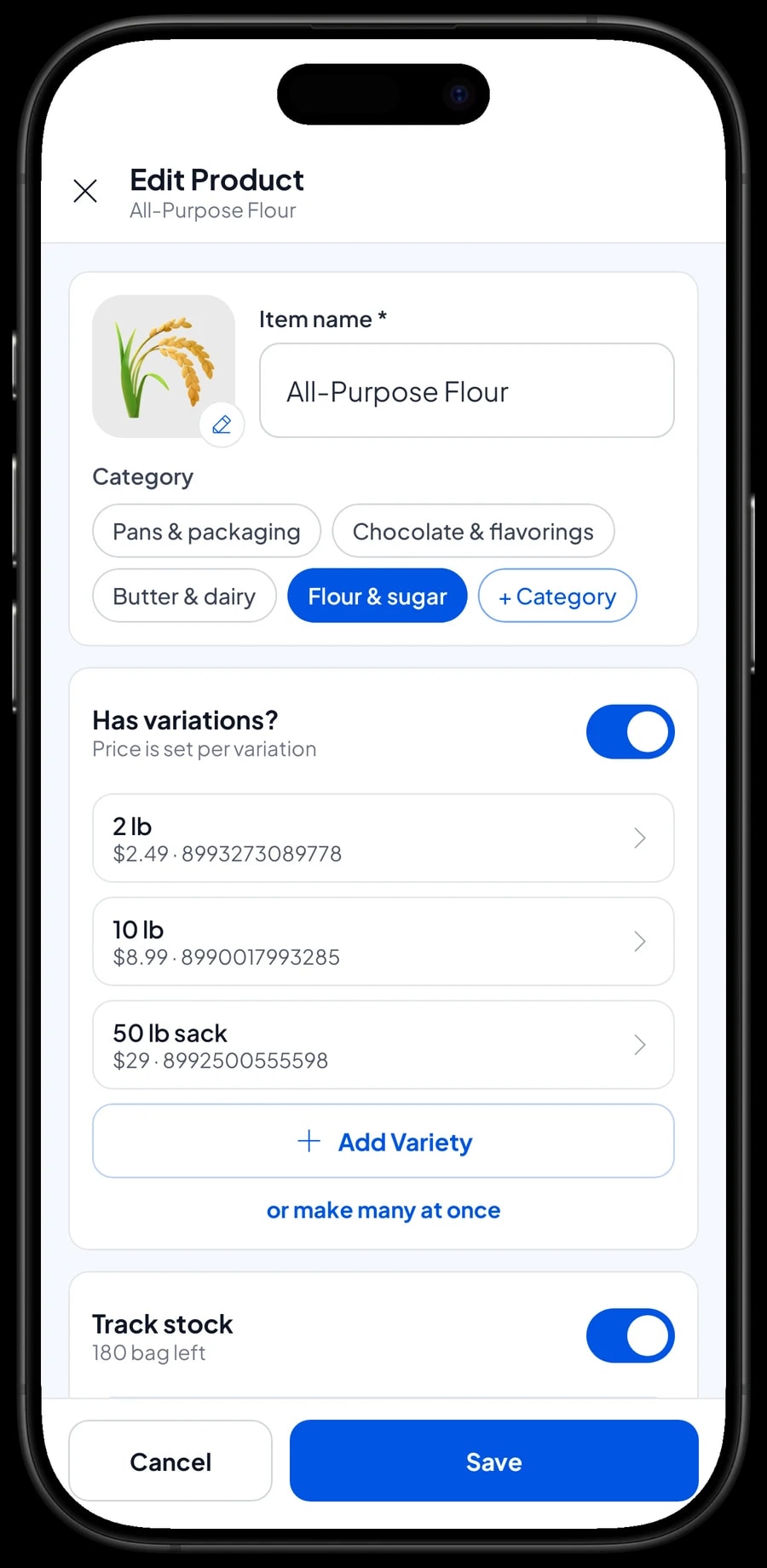
A product sold in several sizes only needs one item with variants. All-Purpose Flour, for example, has 2 lb, 10 lb and 50 lb sack variants. The cashier picks the variant and the price follows. The same works for choices that aren't sizes: dark and white compound chocolate, pandan, vanilla and strawberry flavoring paste, or 8 in and 9 in round cake pans.
Each variant can have its own barcode. Factory packs that already carry a barcode are simply scanned, and packs you repack in the store can get your own barcode label. If you stock hundreds of products, enter the catalog on a laptop first (Windows or Mac) and then use it on the phone or tablet at the counter.
- Step 1: Open Catalog → Categories and create categories such as Flour & sugar and Pans & packaging.
- Step 2: Open Catalog → List Items and add each product with its name, unit and category.
- Step 3: Tap Add Variety for each pack size, such as 2 lb, 10 lb and 50 lb sack, and enter its price.
- Step 4: Enter the barcode on every variant that has one, then save.
Ringing up long shopping lists quickly
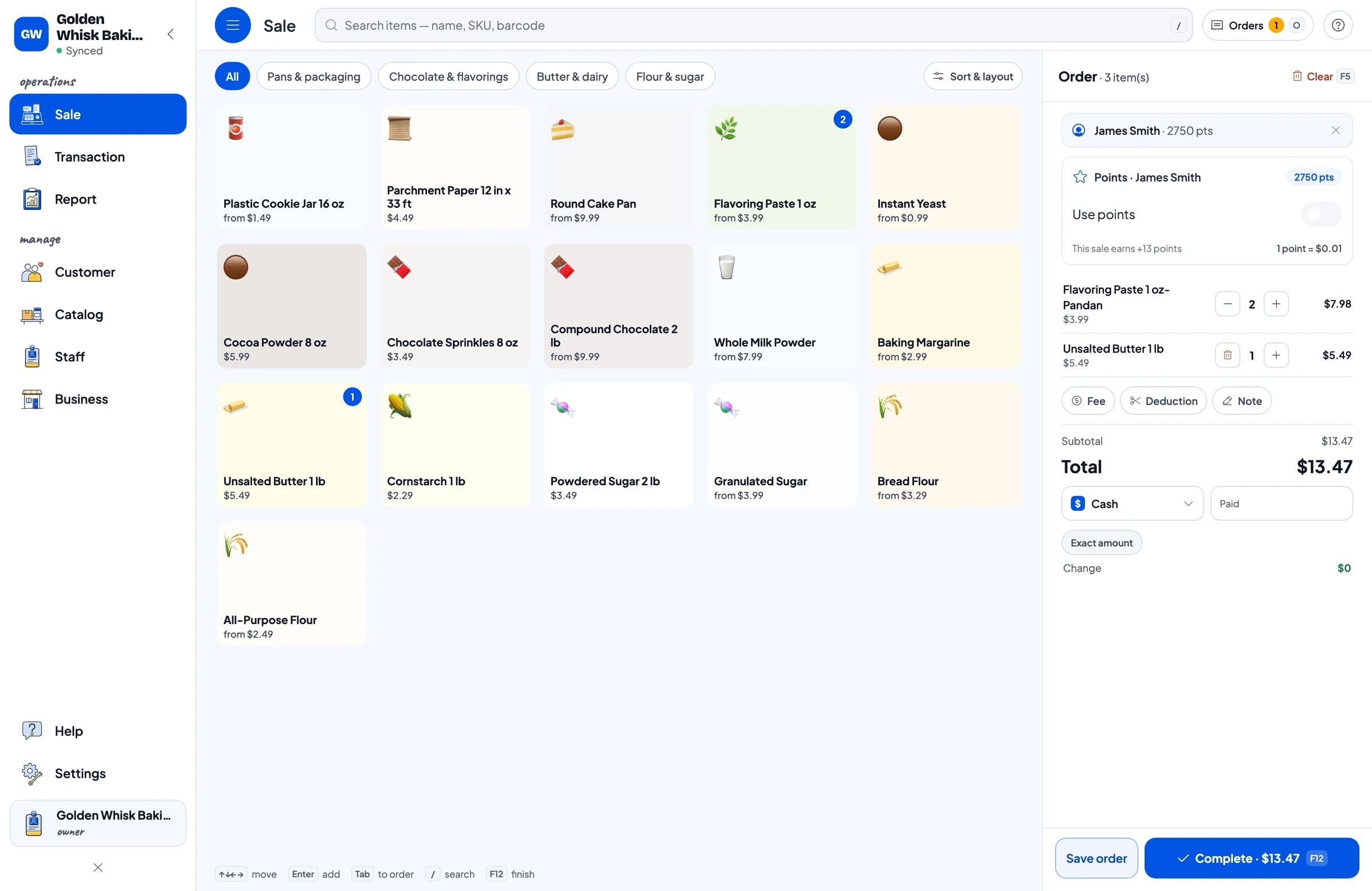
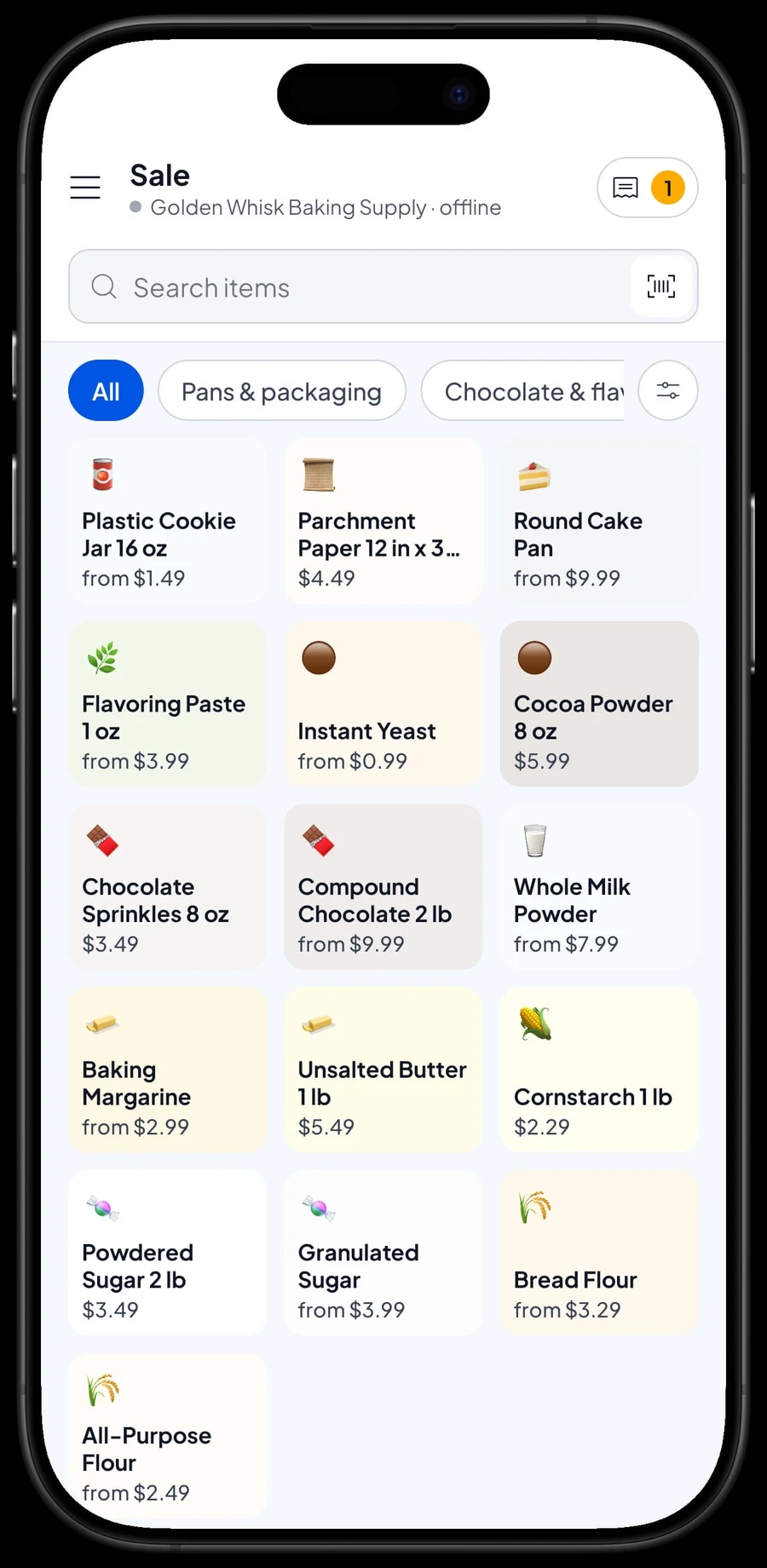
People rarely come to a baking supply store for one thing. A home baker making a birthday cake picks up five or six items, and a small cookie business might bring a list of twenty. On the Sale screen, the cashier taps a product or scans its barcode, picks the variant and changes the quantity. The total is calculated for you, including sales tax if your store charges it.
The cashier can also add a discount, an extra fee, or a note such as "pack the chocolate separately". Set up the payment methods you accept: cash, card, bank transfer, or any other method you create yourself.
Once paid, the receipt can print on a Bluetooth or USB thermal printer, or go to the customer as a web receipt link. A detailed receipt helps small baking businesses match their purchases against their own cost records.
Stock per pack size, suppliers and repacking
In Salesmaster, stock is kept for each variant. That means 2 lb bags, 10 lb bags and 50 lb sacks of flour each have their own count, and every sale takes stock off the variant that was sold. When a delivery arrives, record the new stock in Inventory → Stock, with the purchase price per unit and the supplier. Your supplier list lives in Inventory → Supplier.
One thing to know: selling a 2 lb bag does not take anything off the 50 lb sack. If your store opens sacks and repacks them into smaller bags, record the move yourself. Take the opened sack off stock, then add the smaller bags you packed. With that habit, the app keeps matching what is on the shelf.
Turn on stock tracking only for products you actually want to count. Small odds and ends, like jar lids or ribbon, can stay untracked so the cashier isn't slowed down.
- Step 1: Open Catalog → List Items, pick a product and turn on Stock Tracking.
- Step 2: Open Inventory → Supplier and add your flour, sugar and chocolate suppliers.
- Step 3: When a delivery arrives, open Inventory → Stock and add stock per variant with its purchase price and supplier.
- Step 4: After repacking, take the opened sack off stock and add the smaller bags you packed.
Delivery and phone orders with Save order
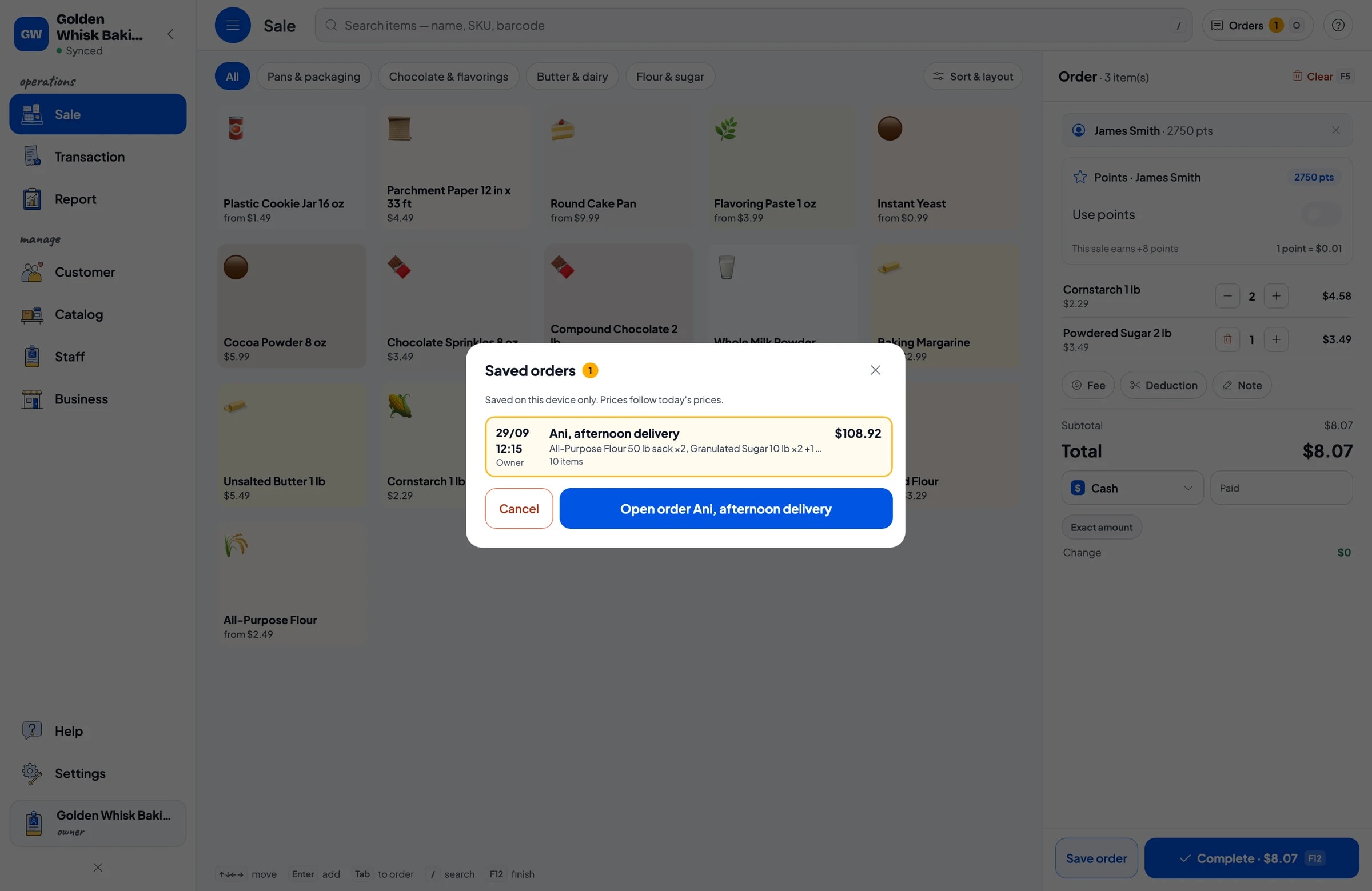
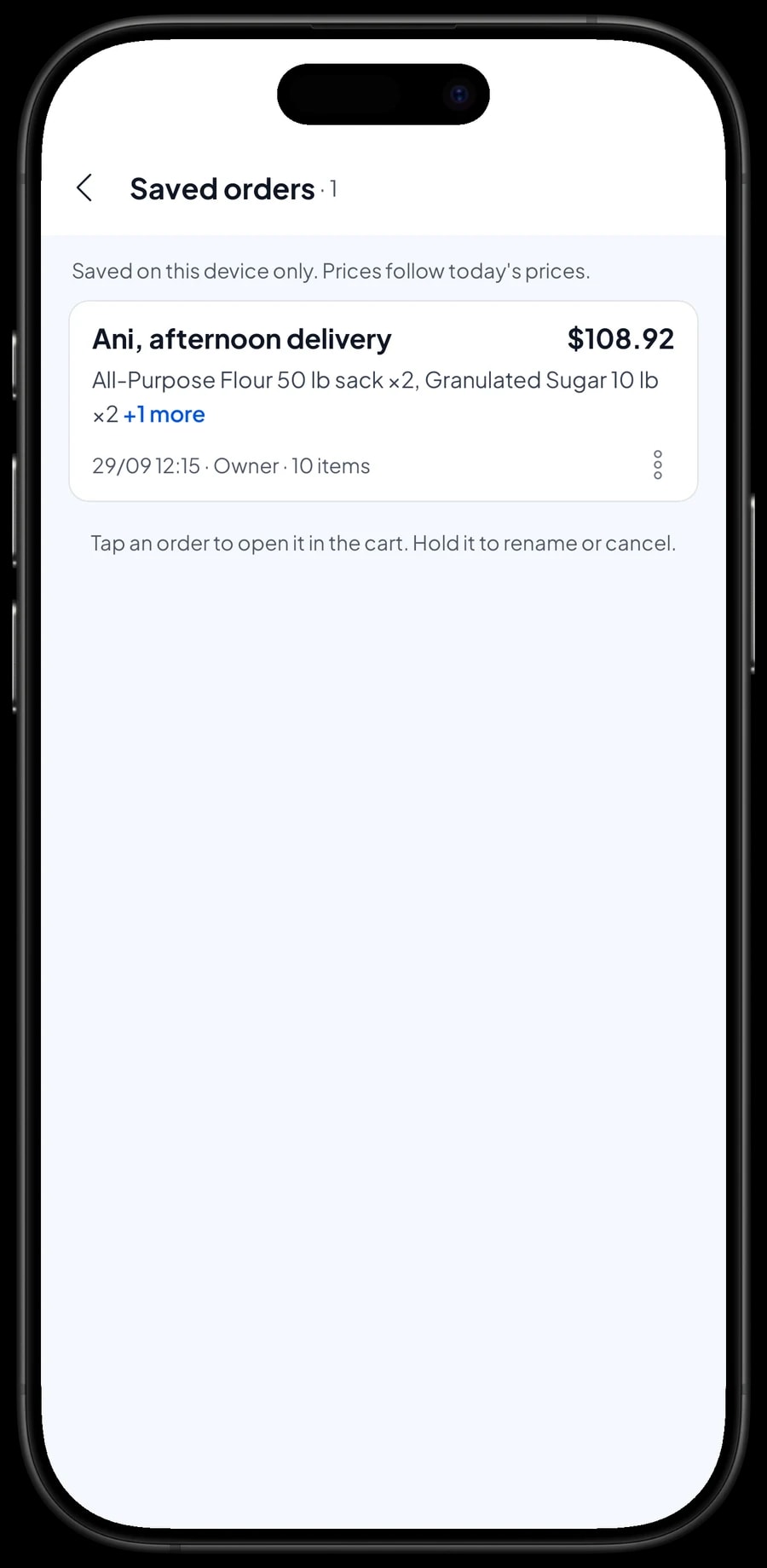
Many baking supply stores take orders by phone or message: a regular baker orders flour and sugar, the order goes out in the afternoon, and it is paid on delivery. For orders like this, put the items in the cart and tap Save order. The cart is kept as a saved order under the name you give it, for example "Ani, afternoon delivery".
The cashier can move straight on to the next customer. When the driver comes back with the money, open Saved orders, pick the order, add anything the customer asked for later, and complete the payment.
A saved order is not counted as a sale and does not take stock off until it is paid, so your reports stay clean if an order is cancelled. Saved orders live only on the device that created them, so finish the payment on the same device. Prices follow the current price list.
Getting ready for the holiday baking season
In the weeks before the big holidays, a baking supply store can get far busier than usual. Cookie makers and gift-box bakers buy in bulk, and butter, sprinkles, cookie jars and parchment paper sell out fast. Get your catalog ready before the rush: check that every pack size and price is right, and that seasonal packs, like a 12-pack of cookie jars, are already set up as variants.
In your reports, look at which products sold most during last year's busy season, and order stock early. If you bring in extra cashiers for the season, give each one a staff account, so everyone who runs the till signs in with their own PIN.
When the store is packed and the internet is slow, the cashier keeps selling. Every sale is saved on the device first and sent to the cloud when the connection is back. Offline mode works for up to 7 days; after that the app needs to connect briefly to sync and verify your account.
Staff and cashier devices
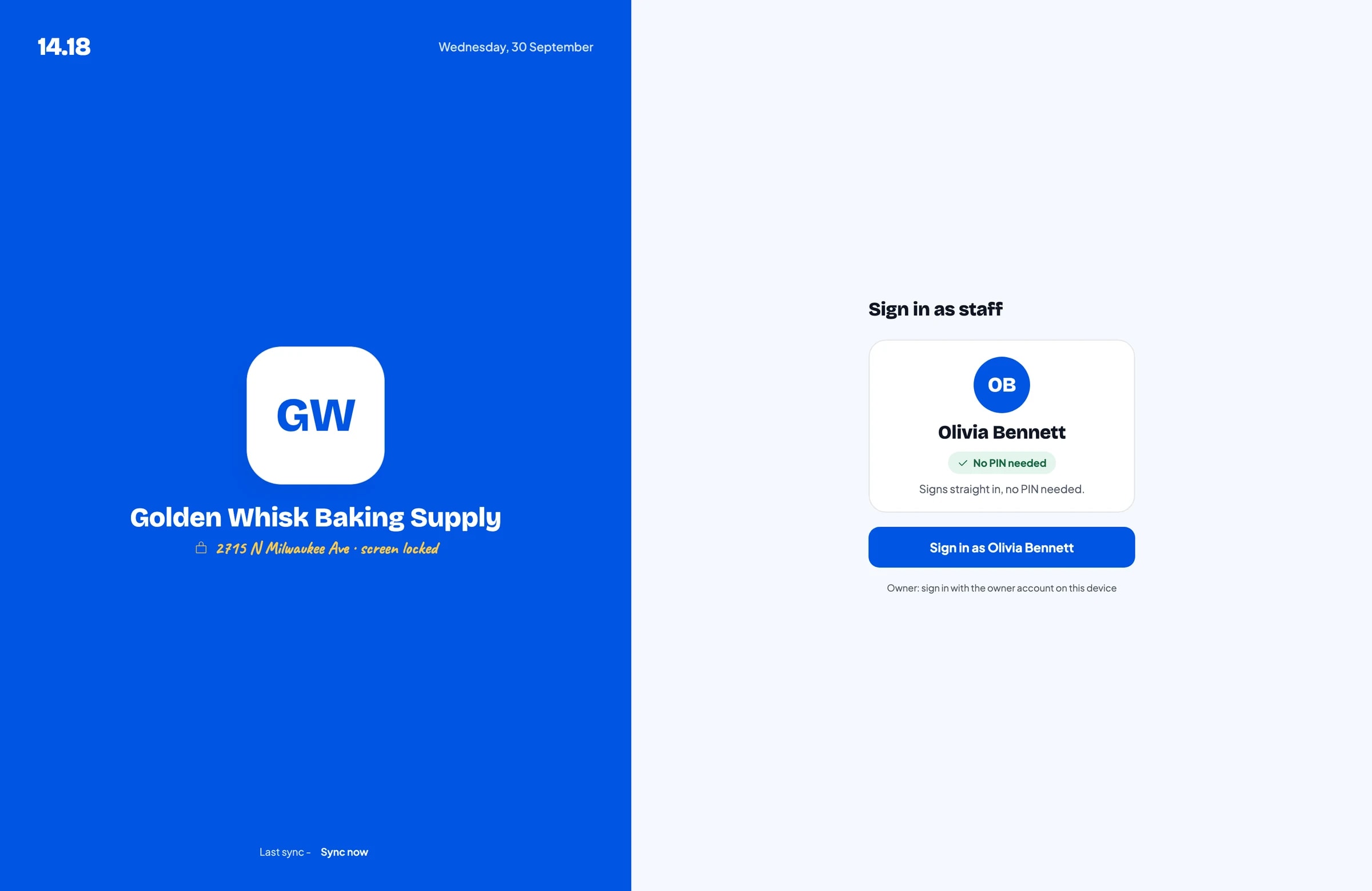
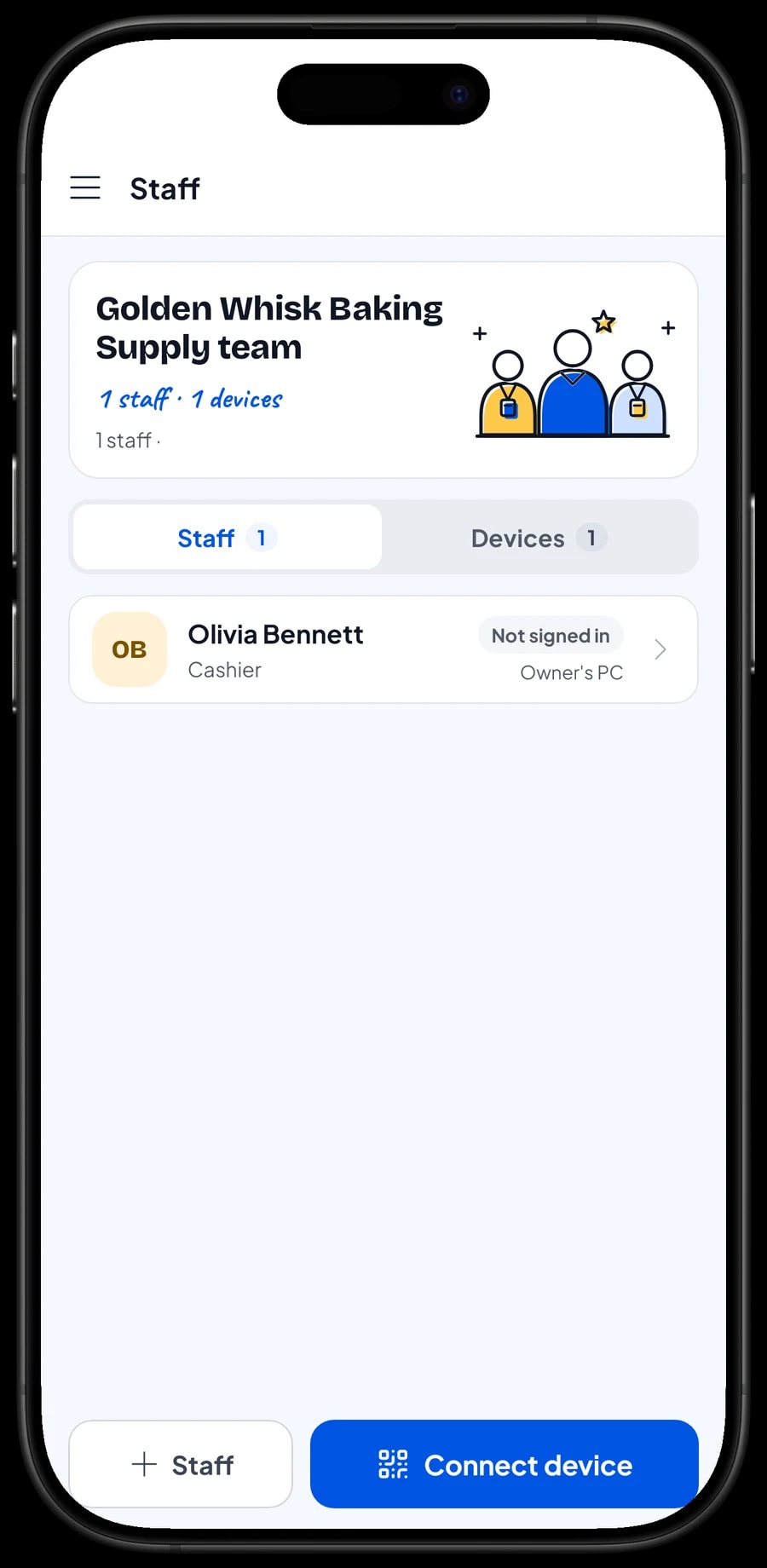
The owner signs in with the main account, and an account is active on one device at a time. Cashiers and store assistants don't need your account: add them as staff, then register a cashier device for them. Staff sign in with a PIN, and you decide what they can see and change. Staff accounts come with Bronze Pro (1 staff) and Silver Pro (2 staff).
Regular bakers: loyalty points and member cards
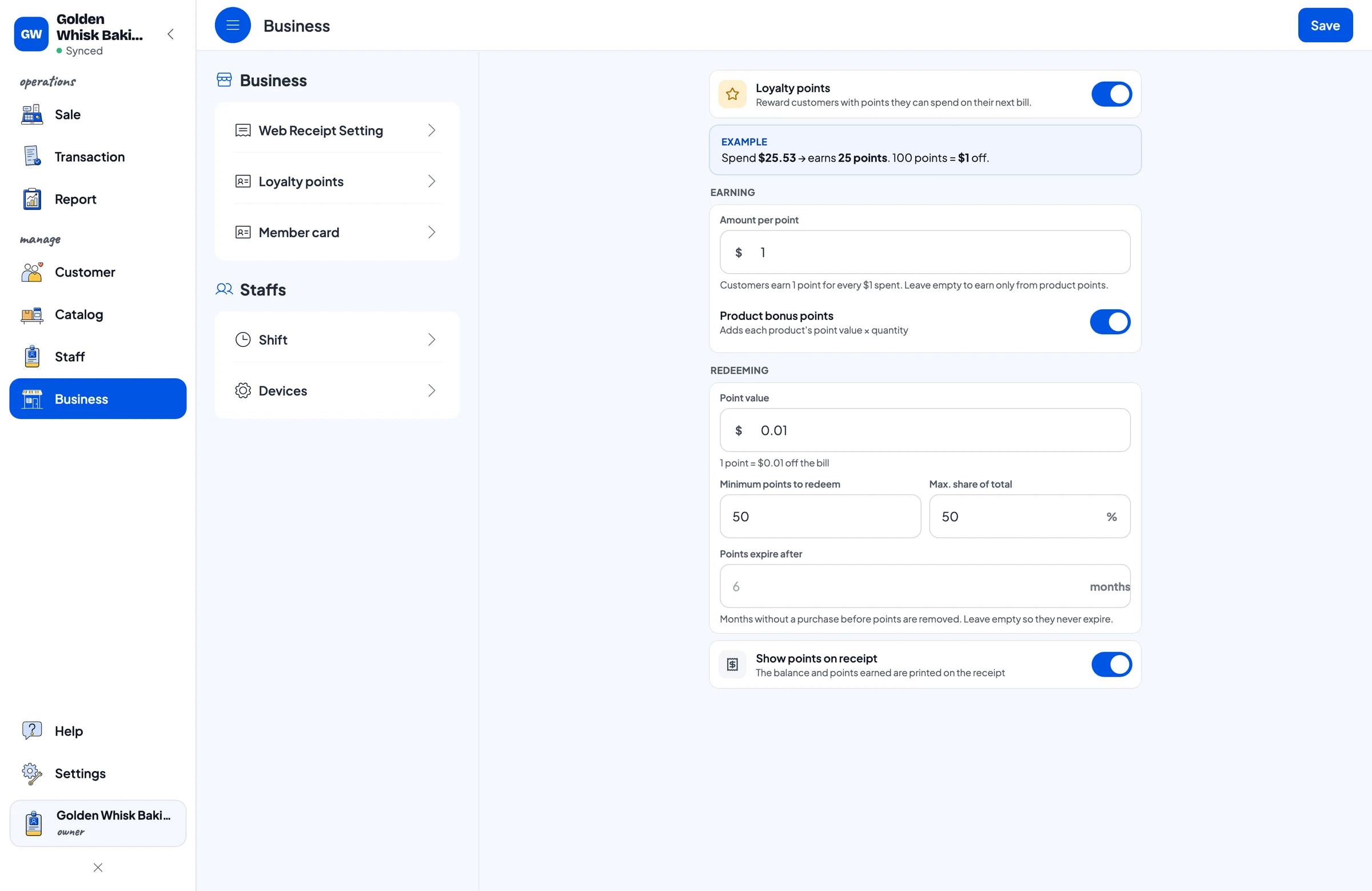
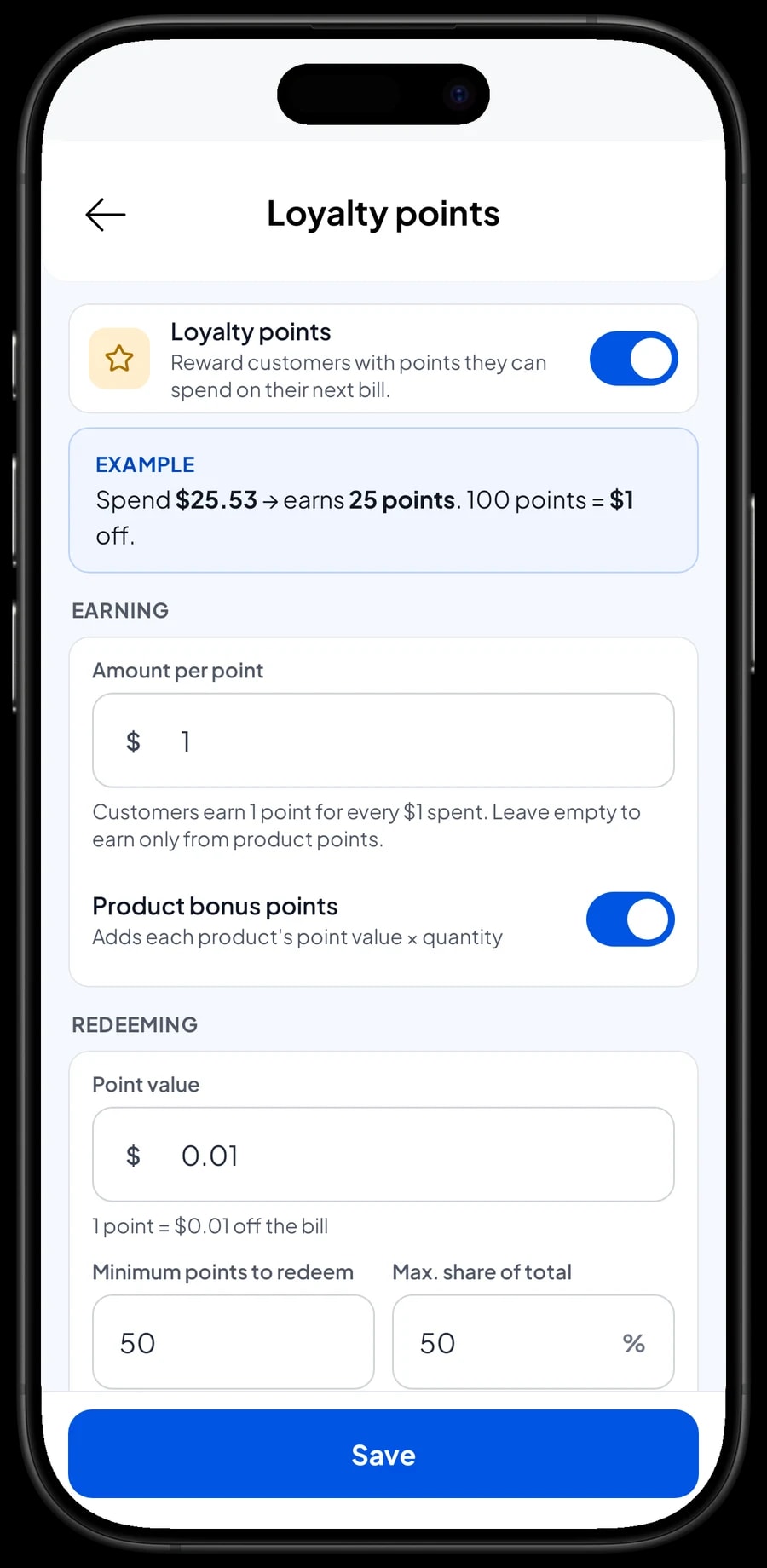
The most valuable customers of a baking supply store are home bakers, small bakeries and caterers who shop every week. Save their details at checkout (a name and phone number is enough) and turn on Loyalty points under Business. You set the rules: the amount spent per point, the value of a point when redeemed, the minimum points to redeem, and the maximum share of a bill that points can cover.
The cashier doesn't calculate anything. Points are added with every sale, and when a customer wants to use them, the discount is applied straight away. Regulars can also get a member card in their name, and their purchase history is kept, so you know who buys flour by the sack and when they last came in.
Sales reports and real net profit
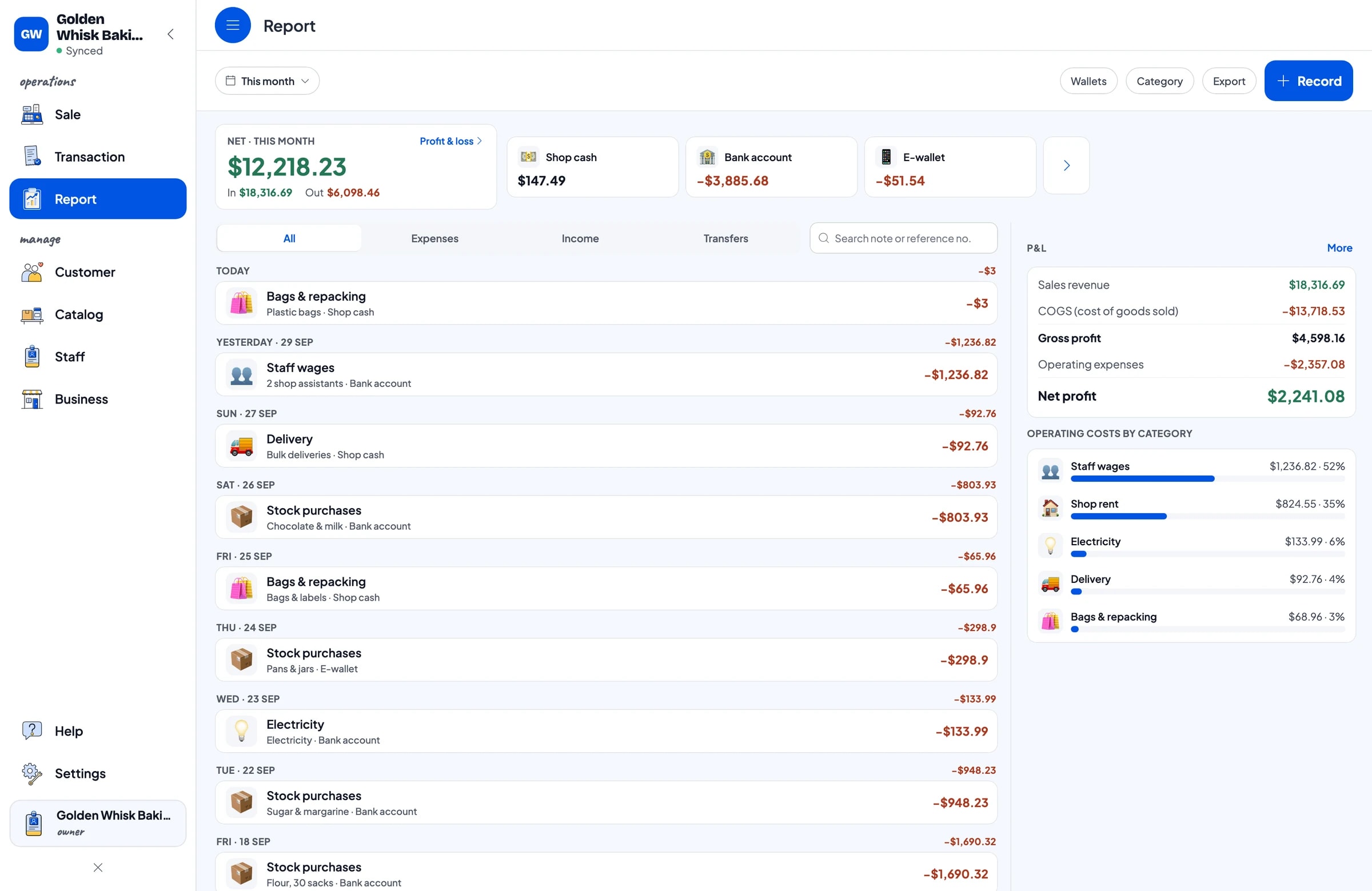
Reports are available by day, week, month and year. You see total revenue, gross and net sales, discounts, tax collected, payment methods, and which products bring in the most revenue. With thin margins, this matters: the best seller isn't always the product that earns the most.
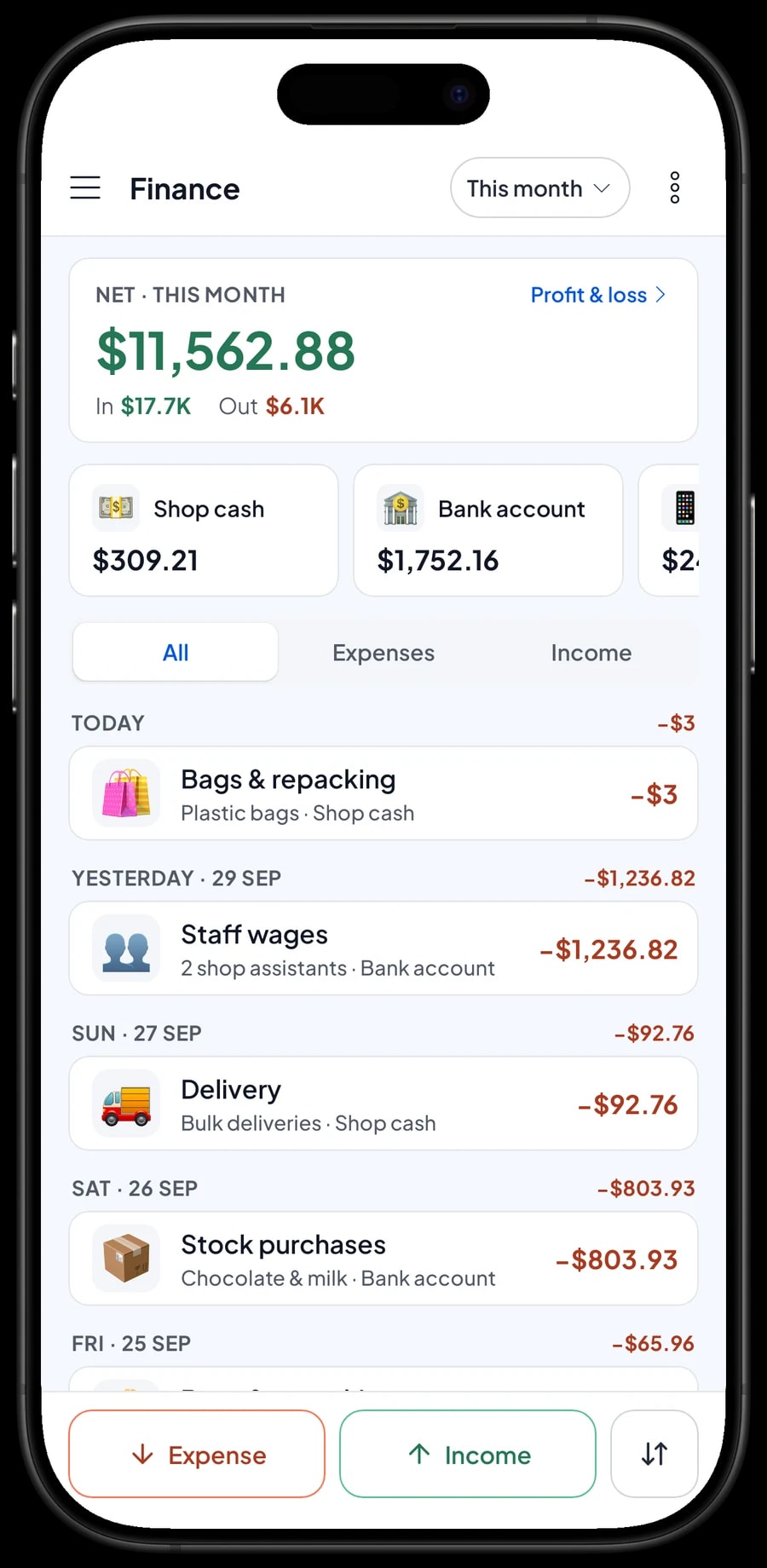
For real profit, record expenses in Finance: stock purchases, bags and repacking supplies, rent, staff wages, electricity and deliveries. Each expense has a category and the wallet it was paid from, such as shop cash, a bank account or an e-wallet. The Finance report then shows revenue minus cost of goods and operating costs: your store's net profit. Cost of goods comes from the purchase prices you record when adding stock.
Reports can be exported to Excel or PDF to send to your accountant or the family members who help run the store.
Get started in a day
You don't need to close the store to switch to Salesmaster. Install the app on the counter phone, tablet or laptop and create an account. Enter your 20 to 30 best sellers first, like flour, sugar, butter, margarine and chocolate, with their pack-size variants. Connect your thermal printer and barcode scanner if you use them.
On day one, run the till as usual and add missing products during quiet moments. In the evening, open the daily report and compare it with the cash in the drawer. Once the cashier is comfortable, record your opening stock per pack size, then start recording expenses in Finance. Within a week or two, your store has complete records of sales, stock and profit.
An example baking supply catalog
Use this table as a starting point and replace the names, pack sizes and prices with your own products.
| Category | Product | Unit | Variants | Barcode |
|---|---|---|---|---|
| Flour & sugar | All-purpose flour | bag | 2 lb, 10 lb, 50 lb sack | Per variant |
| Flour & sugar | Granulated sugar | bag | 4 lb, 10 lb | Per variant |
| Flour & sugar | Cornstarch 1 lb | box | - | From the maker |
| Butter & dairy | Baking margarine | pack | 1 lb, 2 lb | Per variant |
| Butter & dairy | Whole milk powder | bag | 12 oz, 2 lb | Per variant |
| Chocolate & flavorings | Compound chocolate 2 lb | block | Dark, White | Per variant |
| Chocolate & flavorings | Flavoring paste 1 oz | bottle | Pandan, Vanilla, Strawberry | Per variant |
| Chocolate & flavorings | Instant yeast | pack | 0.25 oz packet, 1 lb pack | Per variant |
| Pans & packaging | Round cake pan | pc | 8 in, 9 in | Store label |
| Pans & packaging | Plastic cookie jar 16 oz | jar | Single, 12-pack | Store label |
Every variant has its own price and stock. Products you repack in the store can carry your own barcode label, so the cashier only has to scan.
Which plan fits your baking supply store
Start by counting sales per day. A baking supply store serving about 20 customers a day records roughly 600 transactions a month, and many more in the holiday season.
| Plan | Price | Transactions / month | Staff accounts | Good for |
|---|---|---|---|---|
| Free | Free | 30 | Owner only | To try checkout and pack-size variants before using it for real. |
| Solo Pro | $4.90/month | 3,000 | Owner only | Stores where the owner runs the till. |
| Bronze Pro | $6.90/month | 5,000 | 1 staff | Stores with one cashier on their own device while the owner checks in from theirs. |
| Silver Pro | $9.90/month | 8,000 | 2 staff | Busier stores with two staff on separate devices, such as a cashier and someone repacking. |
Every plan includes checkout, catalog, receipts, reports and offline mode. You can change plans at any time. See pricing →
Frequently asked questions
- Can one product be sold by the bag and by the sack at different prices?
- Yes. Create one item, such as all-purpose flour, and add 2 lb, 10 lb and 50 lb sack variants. Each variant has its own price, barcode and stock, and the cashier just picks the variant at checkout.
- Does selling a small bag take stock off the sack automatically?
- No. Stock is kept per variant, so selling a 2 lb bag only takes stock off the 2 lb bags. If you open a sack to repack it, take the sack off stock and add the smaller bags in Inventory → Stock.
- Can I use a barcode scanner for baking supplies?
- Yes. Enter the barcode on each variant and scan it at checkout. For packs you repack yourself, you can print your own barcode labels and enter them on the matching variant.
- How do I handle orders that are delivered and paid on arrival?
- Put the items in the cart, tap Save order and name it, for example "Ani, afternoon delivery". When the money comes in, open the order from Saved orders and complete the payment. Saved orders live on the device that created them, so finish it on the same device.
- Can I give regular bakers a better price?
- The simplest ways are a discount on the sale, plus loyalty points and member cards for regulars. If larger packs are cheaper per pound, set them up as variants with their own price, so bulk buyers get the sack price automatically.
- Can the store keep selling when the internet is down?
- Yes. Sales are saved on the device and sync when the internet is back. Offline mode works for up to 7 days before the app needs to connect to sync.
- Can two cashiers sell at the same time on two devices?
- Yes, through staff accounts. An account is active on one device at a time, so each extra cashier uses a staff account on their own device and signs in with a PIN. Staff accounts come with Bronze Pro (1 staff) and Silver Pro (2 staff).
Need help setting up your catalog? Chat with our team on WhatsApp →